
The New Toy in the Room: How ‘Toy Story 5’ Reflects on Childhood in the Age of Screens
PC: Disney/Pixar
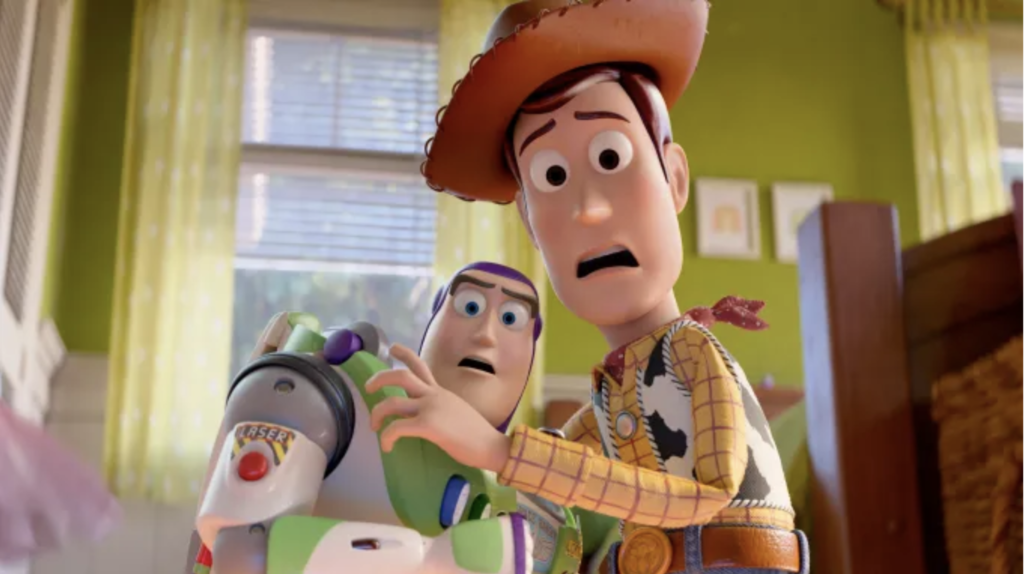
When “Toy Story” debuted in 1995, it represented the future of computer animation. Thirty years later, its fifth installment asks a different question: what happens when the technology that once expanded children’s imaginations begins competing for their attention?
I watched “Toy Story 5” with my 13-year-old nephew and two Gen Z cousins. This time, the film’s central conflict isn’t another toy. It’s the growing tension between digital companionship and real-world play. It landed with an uncomfortable familiarity: Bonnie, now 8, starts to feel embarrassed about playing with toys and reaches for her iPad-like device instead. That quiet moment sets up the question the film keeps returning to. Pixar isn’t subtle about what it’s doing here, and it doesn’t need to be. The metaphor is the movie.
The standout beat came when the toys, watching Bonnie drift toward her new screen, murmured among themselves in an anxious tone about how she was not going to make friends. It’s a small line, but it does a lot of work. It’s not really about Bonnie losing friends — it’s about the toys, and by extension the film, worrying out loud about what a childhood mediated by a screen looks like. The film makes that literal, too: the tablet, trying to help Bonnie socialize, ends up sending a friend request to a classmate on her behalf, and Bonnie later gets mocked in a group chat for still playing with toys. The plotline is essentially about cyberbullying, delivered through the same device that was supposed to fix Bonnie’s social life in the first place.
The phrase “iPad generation” has become shorthand for a certain kind of parental anxiety, and it rarely means anything good. It gets used to describe kids who’d rather swipe than play, who bring devices to restaurants and birthday parties, who struggle to be present. But the same phrase flips positive the moment a kid fixes the family Wi-Fi or walks an adult through a software update. The label has come to represent both admiration and concern, often at the same time, depending on who’s watching. And the film seems aware of that tension without fully resolving it. In the final act, the toys outmaneuver the tablet by exploiting its speech-recognition function, suggesting that technology’s value lies less in substituting human connection and more in enabling it.
Few consumer technologies have shaped modern childhood as profoundly as the iPad. It helped redefine entertainment, education and creativity for millions of children. Yet one of technology’s most influential cultural works, Pixar’s “Toy Story,” is now asking whether that transformation has come at a cost.
Beyond its themes, “Toy Story 5” delivers the animation and humor Pixar is known for, and the eclectic crowd laughed at the same jokes. The technology commentary occasionally lands more like a lesson than a punchline, but that directness is likely what makes it land for younger viewers.
For many who grew up in the 1990s, “Toy Story” has become a shared experience across generations. Parents, aunts and uncles who once watched Woody and Buzz as children are now introducing the franchise to the next generation, making the nostalgia feel like a family tradition. That pull showed up at the box office, too. The film opened to an estimated $160 million in the United States and $152 million internationally, totaling roughly $312 million worldwide and surpassing the opening weekends of both “The Super Mario Galaxy Movie” and “Toy Story 4.”
The film’s evolution reflects how childhood itself has changed, exploring what it means for toys to compete with screens in an increasingly digital world while reminding audiences why imaginative play still matters. Perhaps that’s why the film resonates across generations. Children see an adventure about toys trying to stay relevant. Adults see something more familiar: a reminder that every generation’s idea of childhood changes with technology, and that preserving imagination may matter just as much as embracing innovation.
“Toy Story 5” doesn’t argue that children should put away their screens. It argues that screens cannot replace the messy, imaginative and deeply human experiences that shape childhood. In the film’s final act, technology succeeds not by replacing friendship but by helping make it possible. That’s a more optimistic message than its premise initially suggests, and perhaps a more realistic one for a generation growing up with both toys and tablets.
In 1995, computers made it possible to create a world where toys came to life. Three decades later, “Toy Story 5” asks what happens when those same technological advances begin competing with the imagination they once helped inspire. That full-circle moment is what makes the film feel less like another sequel and more like a reflection on the digital age itself.